
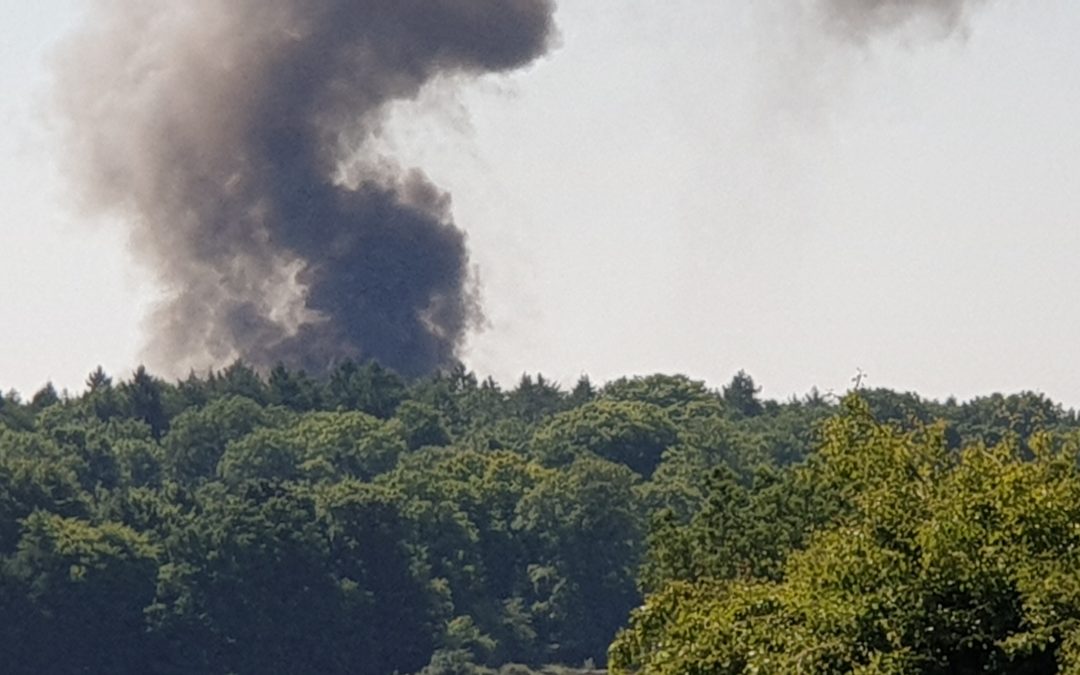
Is Disaster Planning a useful exercise? For this business, the worst nightmare possible happened last weekend. They had a major fire! What actually happens when a fire occurs in a business and is it something you should plan for? Today we look at planning for the worst-case scenario from an IT perspective and determine what you need to do now in order to make recovery a possibility.
Background
Last weekend I looked out of my home office window and saw billowing smoke rising up from the forest. My heart sank, my home overlooks Puzzlewood in the Forest of Dean, it is an amazing ancient woodland and has been a film location for everything from Star Wars and Harry Potter through to TV series such as Game of Thrones and Merlin.
I decided to drive up and see if there was anything I could do to help but was pleasantly surprised to find that the woodland was not ablaze but still looking as amazing as ever. However, a local business that utilises industrial units half a mile from the forest was certainly alight and had gathered a large number of firefighters and police. With roads blockaded and the fire being fought by the professionals I returned home to reflect.
I wondered, had the owners of the business made a plan for this sort of disaster? Had they got insurance? Had they got a back-up of their data?
Disaster Planning
If you own a business long enough the chances are at some point it will have a disaster that needs to be dealt with. I guess it depends on how you define a disaster but in my world a disaster might include:
- A fire.
- A flood.
- Break-in / robbery.
- Ransomware attack (such as the one shown in our video)
- Failure of a significant piece of equipment.
- A member of staff that damages data by maliciously or accidentally deleting.
Why would you do this before an event?
There are a lot of reasons to spend some time thinking through your business response to a disaster. The obvious ones are around making decisions upfront. Have you ever been in overwhelm? Trying to make any decision when deprived of sleep and facing potential ruin is difficult and I have personally made some wrong decisions “in the moment” only to regret them later. But there is a secondary reason for taking time to make the plan before it is needed; it is about the availability of information.
Do you have a record of insurance phone numbers and policy numbers? Can you recover information even if a fire destroys your entire office? How about details of companies that have supplied equipment you might need replaced? Even minor details like the name and out-of-hours phone number of the company that can fit emergency doors at 2am can be really useful. If you have this information upfront your disaster might be nothing more than a slight blip to your day. Without this information you might spend hours going in circles.
What is in a disaster planning document
A disaster planning document, fundamentally, is a reference point in the case of emergency. The aim is to pre-think about all of the things that might need to happen both during, immediately after and in the long-term. It is useful to break this up into different disasters and although there will be some overlap and repetition, you will find having the right information for each disaster will make the recovery much easier.
Smaller business have a small management team (sometimes one person) but that doesn’t mean that all staff cannot get involved. By having a defined outcome required for each task and ensuring the right information is available it is possible to get everyone involved, share the workload and get back to normal as quickly as possible.
As an example, let’s take a fire to an office, tasks here might include:
| Task | Outcome | Info Needed | Estimated Cost (1) | Day |
| Phone Insurance Company | Open case and get reference what next / when | Phone number Policy number Policy documentation (to check clauses) |
1 | |
| Phone staff | Instruct staff to work from home until further instructed | Mobile numbers of staff List of people on holiday |
1 | |
| Locate computer to work on |
Need at least one computer with ability to access documents and email for each member of staff operating on this document.
|
IT Company phone number | 1 | |
| Divert Phone Calls |
Divert all phone calls to call answering service and have them answer most of the questions based on script For specific questions that need to be answered in-house have calls transferred to mobile
|
Phone number of Telecoms provider Phone Number of outsourced Call Answering
Script for Call Answering
Mobile numbers |
1 | |
| Email to customers |
Inform customers of fire and extent to which it might affect delivery of goods / service
Inform them how they can help – phone a number / send an email / do nothing for a few days.
|
List of customers awaiting goods / services
Pre-scripted email that has been agreed by management team |
1 | |
| Find new office space | Locate a new office to work from |
How many staff
Equipment supplied as part of rent
Internet connectivity – is it fast enough
Furniture – is it included?
|
£3000 up front | 1 |
| Order new IT kit |
Ensure new IT kit can be delivered to new office
All equipment to have programs restored |
What type of computers are need (PCs / laptops / servers etc)
List of software needed for each computer
List of locations to download software e.g. Sage Line 50c
Usernames / Passwords / licence keys for software
|
£1000 / computer
|
2 |
| Data Restored |
Ensure data is restored to last known good copy and identify anything missing. Needs to be done ASAP to allow time for download to local equipment.
|
Who backs up data. Which computers / servers need what data Timescales Ability to host the data in the cloud as a short term measure
|
1 |
(1) Obviously, costs should be paid by the insurance company but it may be necessary for the business to pay up-front for certain items and claim this back a few weeks later. This means this document can help to plan a financial contingency as part of the process.
This table needs a lot more thought but to be fair it is possibly the biggest disaster most businesses will have to deal with and from this many other disaster plans can be created with ease.
What Data to Backup?
Check back next week when we will look at the type of data you need to be backing up, where it should be stored and the importance of testing procedures to ensure data can actually be used in an emergency.
How can I get help
A good IT support company will be able to assist you with planning for a disaster. If you would like us to check through your IT disaster planning document we have engineers available.
What next?
If your business would like to talk about planning for disasters or secure data storage then fill out our contact form, phone us or click on the appointment button below and lets start a conversation to see if we are able to help you and your business.
Our guarantee:
- There are no hidden charges – this is a 100% free 15 minute consultation with no hidden charges.
- We will never spam you or sell on your contact details.
- We will treat your information with absolute confidentiality.
Other Posts for you to Enjoy